

Why Human Error Is the Leading Cause of Cybersecurity Breaches
Every organisation depends on its people to stay secure, and yet human error remains the biggest factor in cybersecurity breaches. According to industry reports, 95 % of data breaches involve some form of human mistake, from clicking malicious links to mishandling sensitive information.
Phishing and social engineering attacks account for a large share of these incidents, with human weakness behind 60 % or more of all cyber breaches globally.
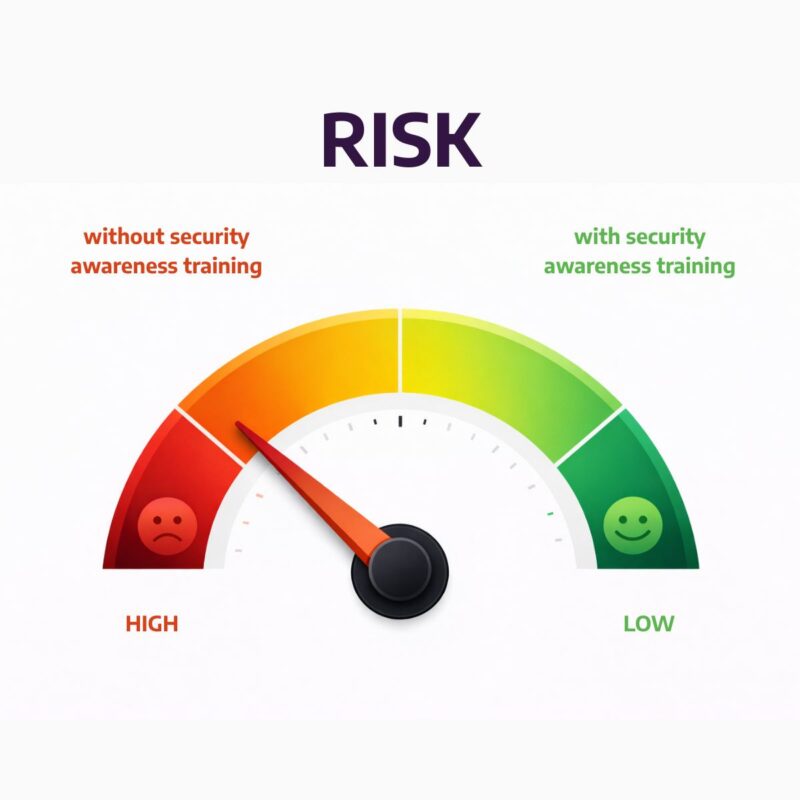
The good news? Security awareness training isn’t just a compliance checkbox, organisations that implement structured programmes can see up to an 86 % reduction in phishing susceptibility and significant risk improvement.
At CommSec, our Security Awareness Training for Users equips your workforce with the knowledge and habits that turn employees from the weakest link into a proactive first line of defence. By combining real-world examples, interactive learning and measurable outcomes, we help organisations reduce risk, improve reporting, and build a truly security-aware culture.
Main Benefits of Security Awareness Training & Phishing Simulation
Managed Services
For organisations with limited time or resources, CommSec delivers fully managed security awareness programmes in partnership with world-leading providers, handling delivery end-to-end and providing actionable, continuous reporting.
Intuitative set-up & Interface
Easy to set up on any computer network. Training campaigns, quizzes and simulated attacks can be formed and utilised within minutes of the initial setup. All content is delivered in-browser and accessible on PC, Laptop or mobile device.
Tailored Content
Security concerns are global, but some topics require additional regional or specific to industry knowledge. We provide bespoke training for organisations like Education, Finance, Government, SMEs etc.
SHORT MODULES
The training videos are developed to be short and concise, keeping staff productive and informed in a matter of minutes.
Customisable Content
The training programme can be fully customised, including phishing templates that match your branding, simulated attachments based on company documents, and advanced email spoofing to test realistic user responses.
GAMIFIED & ENTERTAINING
Engaging and enjoyable security awareness training. Our training content is innovative, engaging, kept up to date with the latest trends and threat landscape.
What is security awareness training for employees?
Security awareness training for employees is a structured programme that teaches staff how to recognise, avoid, and report cyber threats such as phishing, malware, social engineering, and data misuse.
The goal is to reduce human error by giving users practical, role-relevant guidance on how attacks actually occur and what safe behaviour looks like in day-to-day work. Effective training focuses on real-world scenarios rather than abstract security theory.
How does security awareness training reduce phishing risk?
Security awareness training reduces phishing risk by improving users’ ability to identify suspicious emails, links, attachments, and impersonation attempts before they cause harm.
Training typically combines short educational modules with simulated phishing exercises, allowing users to practise recognising threats in a controlled environment. Over time, this lowers click-through rates on malicious emails and increases early reporting, which helps security teams respond faster and limit impact.
How often should user security training be updated?
User security training should be updated regularly to reflect evolving attack techniques and organisational changes.
Most organisations benefit from:
-
Baseline training for new starters
-
Ongoing refresher training delivered monthly or quarterly
-
Targeted updates when new threats or business risks emerge
Frequent, shorter training sessions are more effective than annual one-off courses, as they reinforce safe behaviour without overwhelming users.
What topics are covered in security awareness training?
Security awareness training typically covers the most common and highest-risk attack vectors faced by organisations, including:
-
Phishing and spear-phishing
-
Social engineering and impersonation attacks
-
Password hygiene and multi-factor authentication
-
Safe use of email, web, and cloud services
-
Data protection and handling sensitive information
-
Incident reporting and escalation procedures
Advanced programmes may also tailor content by role, addressing risks specific to finance, IT, executives, or remote workers.
Is security awareness training mandatory in Ireland or the EU?
Security awareness training is not always explicitly mandated by law; however, major regulatory frameworks such as NIS2, DORA, and CyFun clearly recognise it as an essential control.
Regulations such as GDPR require organisations to implement “appropriate technical and organisational measures” to protect personal data. Training staff to handle data securely and recognise threats is widely considered a core part of meeting these obligations, particularly during audits or incident investigations.
How is security awareness training effectiveness measured?
The effectiveness of security awareness training is measured using behavioural and operational metrics rather than course completion alone. Common indicators include:
-
Phishing simulation failure and reporting rates
-
Reduction in repeat user mistakes
-
Time taken to report suspected incidents
-
Audit findings related to human risk
Tracking these metrics over time allows organisations to demonstrate measurable risk reduction and continuously improve their training programme.
Why is it important to train your employees in Cyber Security?
By completing security awareness training, employees learn to:
- avoid phishing and other types of social engineering cyberattacks,
- spot potential malware behaviours,
- report possible security threats,
- follow company IT policies and best practices,
- and adhere to any applicable data privacy and compliance regulations (GDPR, PCI DSS, HIPAA, NIS2 etc.)
More Resources
On-demand Webinar – How to implement a cybersecurity-first culture for the modern workplace.
Video – Introduction to Cyber Security Awareness Training by SafeTitan
FAQ's
Who should receive security awareness training?
Security awareness training should be provided to all users with access to organisational systems or data, including full-time staff, contractors, and temporary workers. Human-targeted attacks do not depend on job role, making broad coverage essential.
How long does security awareness training take to complete?
Most programmes are delivered in short, modular sessions that take between 5 and 15 minutes per module. This approach minimises disruption while reinforcing learning through regular repetition rather than one-off courses.
Can security awareness training be tailored by role or risk?
Yes. Effective programmes can be tailored by role, department, or risk profile, with additional focus for high-risk users such as finance teams, IT staff, and senior management. Targeted training improves relevance and measurable outcomes.
How quickly can security awareness training be rolled out?
Security awareness training can typically be deployed within days, depending on the size of the organisation and the level of customisation required. Cloud-based delivery allows rapid onboarding without complex infrastructure changes.
Does security awareness training replace technical security controls?
No. Security awareness training complements technical controls such as email filtering, endpoint protection, and access management. Training reduces the likelihood that users bypass or undermine these controls through unsafe actions.