
Summary
LLMjacking is the theft and resale of access to large language models and cloud AI resources. In October 2026, Fireworks AI reported that attackers reached its development machines through a third-party cloud provider and ran an unauthorised workload, while Binance linked a $6.3 billion theft to a compromised DevOps laptop. Both incidents show that developer environments, often exempt from web filtering, MFA and standard builds, are a growing weak point. CommSec recommends bringing dev machines under the same security controls as the rest of the business, scoping and monitoring AI API keys, and removing live personal data from development systems in line with GDPR.
LLMjacking and the Developer Blind Spot: Why Dev Machines Are the New Front Door
Another AI company has been breached, and once again the attackers came in through the development environment. In its 9 November update, Fireworks AI confirmed that a security incident at a third-party cloud provider hosting its R&D machines gave attackers a route into Fireworks development machines on 24 October. From there, they ran an unauthorised workload that exposed further customer data, including billing details and, for some customers, incomplete model weights and datasets. Palo Alto Networks Unit 42 is supporting the forensic investigation. The evidence links the attack to a financially motivated group whose business model has a name: LLMjacking.
What is LLMjacking?
LLMjacking is the theft and resale of access to large language models and the cloud resources behind them. Attackers steal cloud credentials, API keys or session tokens, then use the victim’s account to run expensive AI workloads or sell that access on. Research published on 2 November by Google Threat Intelligence Group and Mandiant describes underground services called LLM mixers. These pool stolen credentials, route customer requests through victim environments, and sell premium model access well below the legitimate price. The victim pays the bill.
The financial damage builds quickly. Unlike cryptojacking, which consumes resources gradually, LLMjacking can generate more than $100,000 in fraudulent cloud charges in a single day. Some organisations reached $1 million before they revoked access. The most common entry points are exposed cloud credentials, service account keys, GitHub tokens, active session tokens and LLM API keys. In most businesses, the place where all of those sit together is a developer’s laptop.
The same pattern at Binance
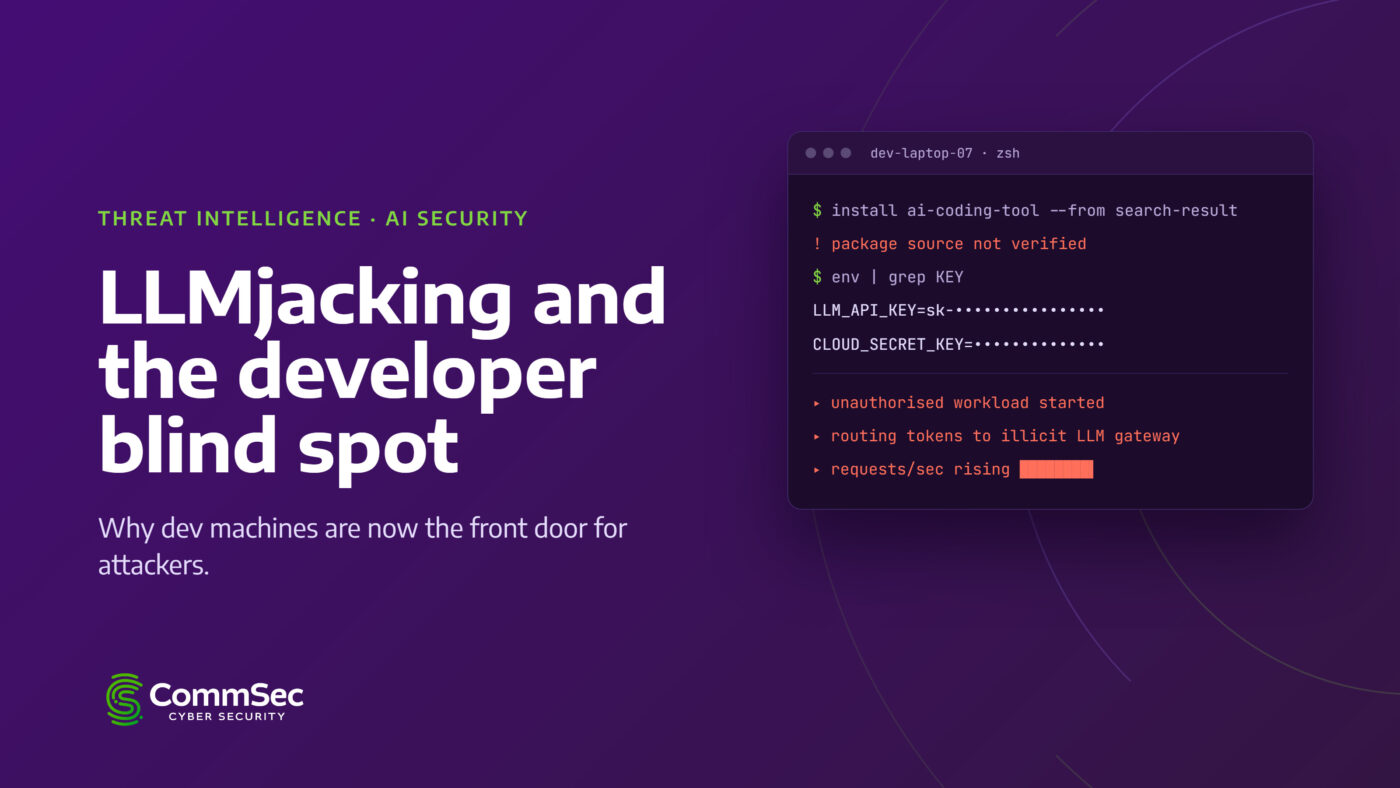
Fireworks is not an isolated case. On 29 October, Binance lost around $6.3 billion from its hot wallets. Its initial findings pointed to a compromised DevOps engineer’s laptop, which gave the attacker access to a service container that submitted unauthorised withdrawals. Later reporting on Binance’s preliminary findings said the engineer had downloaded a tampered installer while trying to set up a popular AI coding tool found through a search engine. Different targets and different motives, but the same front door.
“Every few weeks we read the same line in a breach notice: an unauthorised workload was run on a dev machine. That is not a coincidence. Development is where security controls are weakest and where the most valuable credentials live. Attackers know it, and they are going straight for it.” Barry Rooney, CTO, CommSec
Why development environments are a security blind spot
The problem is rarely technical. It is cultural. In most organisations, the security team does not tell developers how to work. Dev teams are often allowed to bypass web filtering, skip MFA on certain systems, run their own builds and install tools without approval. The reasoning is that developers are skilled professionals who understand the risks and will not harm the business.
Barry sees it differently. “Developers are professionals, but professionals under deadline pressure take shortcuts,” he says. “Often those shortcuts are signed off by senior management to get the job done. When that happens, security exceptions stop being exceptions and become the operating model.” The result is a group of machines with the broadest access, the most credentials and the least oversight in the company.
Live data in dev systems is a GDPR problem waiting to happen
There is a second risk that makes a dev breach far more serious. Many organisations copy live production data into development and test systems because it is quicker than building realistic test data. Under GDPR, this is very difficult to justify. The principles of purpose limitation and data minimisation, together with the requirement for data protection by design, mean personal data should not sit in a test environment when anonymised or synthetic data would do the job.
In practice, many teams do not realise this. When a dev machine holding real customer records is compromised, what might have been a contained technical incident becomes a reportable personal data breach. That means notifying the Data Protection Commission within 72 hours, and potentially the affected individuals as well.
Securing AI coding tools without slowing developers down
At CommSec, our own developers now use AI coding tools such as Claude Code. We face the same challenge as our clients: how to protect those tools without creating so much friction that people work around the controls. Heavy-handed restrictions rarely work. Clear, consistent guardrails do.
The starting point is to treat developer machines as high-value assets, not exceptions. That means full endpoint detection and SOC monitoring with no blanket exclusions for dev builds, and phishing-resistant MFA for everyone, including engineers. It means scoping every AI and cloud API key to specific models, environments and spending limits, scanning repositories for exposed secrets, and alerting on unusual spikes in AI usage. AI tools should come from verified sources or a managed package repository, never from a search result. Development environments should be segmented from production, and live personal data should be replaced with anonymised or synthetic test data.
The Fireworks and Binance incidents show that attackers have found the gap between how security teams want developers to work and how they actually work. Closing that gap is a leadership decision as much as a technical one. If you would like an independent view of your development environment, or to discuss how our Managed SOC and AI Detection and Response services monitor these risks, our team is happy to talk.
FAQ
What is LLMjacking? LLMjacking is the theft and resale of access to large language models. Attackers use stolen cloud credentials or API keys to run AI workloads on a victim’s account, or sell that access through underground services, leaving the victim with the bill.
How much can an LLMjacking attack cost? Google Threat Intelligence Group and Mandiant report charges of more than $100,000 in a single day, with some organisations reaching $1 million before access was revoked.
Why are developer machines targeted? Developer machines hold cloud credentials, API keys, tokens and source code, and are often exempt from controls such as web filtering and MFA. That makes them an efficient route into cloud and AI environments.
Is it legal to use live customer data in test environments under GDPR? It is very hard to justify. GDPR’s principles of purpose limitation and data minimisation, and the requirement for data protection by design, mean anonymised or synthetic data should be used wherever it will do the job.
How can businesses secure AI coding tools such as Claude Code? Install them only from verified sources, bring developer endpoints under EDR and SOC monitoring, enforce MFA, scope API keys by model and spend, scan repositories for secrets and alert on unusual AI usage.
Sources
- Fireworks AI: Update on October 2026 security incident
- Google Cloud Threat Intelligence: LLMJacking, Monetizing Compromised Cloud Models
- BleepingComputer: Google, LLMjacking attacks rack up $1 million in cloud AI charges
- Dark Reading: LLMjacking emerges as thriving cybercriminal enterprise
- BleepingComputer: Binance links $6.3 billion crypto theft to compromised DevOps laptop
Mezha: Binance reveals details of $6.34B hack